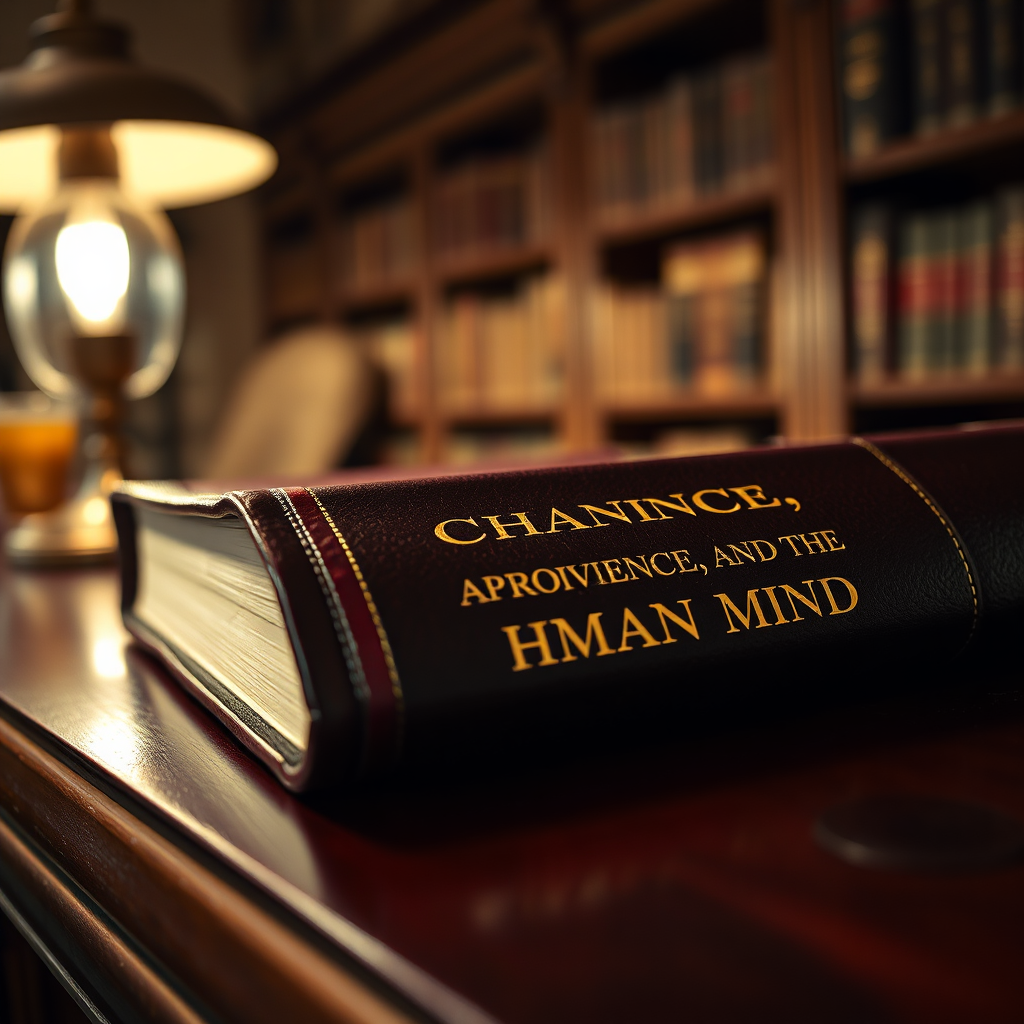
Chance,
Providence,
& The Human Mind
An ontological exploration into the intersections of stochastic reality, divine agency, and the interpretive architecture of consciousness.
"Is the roll of the die a silent prayer
or a blind collision?"
In this definitive philosophical inquiry, the author navigates the perilous waters between the mechanics of probability and the ancient concepts of divine providence. At its heart, the manuscript posits that the human mind does not merely observe chance, but actively structures it into a narrative of meaning.
By synthesizing classical metaphysics with modern stochastic theory, "Chance, Providence, and the Human Mind" challenges the contemporary dichotomy of a purely random universe versus a strictly deterministic one. It introduces a third path—the "Providential Emergence"—where the human intellect acts as the bridge between the chaotic and the ordained.
"Chaos is not the absence of order, but the presence of an order yet to be decoded by the mortal observer."
Structural Pillars
A detailed traversal of the manuscript's internal architecture.
The Stochastic Fabric
Deconstructing the mathematics of randomness and its implications on our understanding of objective reality. Are there truly random events, or only insufficient data?
Providential Agency
Revisiting classical teleology in the age of quantum mechanics. How the concept of a "First Cause" survives in a world governed by probability wavefunctions.
The Mind as Mirror
The psychological and neurological frameworks that permit the human psyche to find patterns, purpose, and providence within the noise of existence.

Dr. Julian H. Thorne
Dr. Thorne is a Senior Research Fellow at the Institute for Metaphysical Studies and has spent over three decades exploring the dialogue between religious philosophy and empirical science. His previous works, including *The Architecture of Grace*, have been translated into twelve languages.
This latest manuscript represents the culmination of a decade of research into the "Stochastic Providence" paradox. Dr. Thorne currently resides in Oxford, where he continues to lecture on the ethics of belief and the philosophy of mind.
"Providence does not negate chance;
it permeates it, transforming the random into the revelatory."
Complete the Inquiry
The full 240-page manuscript is available for academic study and personal reflection. Download includes the primary text, a comprehensive bibliography, and 12 original illustrations by Marcus Vane.
Published by Veritas Academia Press.
We use cookies and similar technologies to improve your browsing experience and personalize content. By continuing to use our site, you agree to our use of cookies.